Practical AI adoption
Bringing It All Together
Where AI Actually Fits in a Business
Over the past several posts I've been talking about something that often gets skipped in AI discussions.
Thinking.
We started with clarity.
What problem are we actually trying to solve?
Then we talked about story.
Every business has one. Customers, constraints, goals, risks, tradeoffs.
Then we talked about conversation.
AI works best when it's part of an ongoing discussion, not when we treat it like a magic command line.
Then we looked at examples.
A yoga studio exploring new classes.
A yoga studio considering a physical product.
Service risk versus inventory risk.
Each time, the same pattern showed up.
Define the story.
Define the constraints.
Ask better questions.
Only then does AI enter the picture.
And that leads to the question I hear most often from small and mid-sized businesses.
"Okay... but what tools should I use?"
It's a fair question.
There are hundreds of them now.
Writing tools.
Image tools.
Video tools.
Marketing tools.
Coding tools.
Automation tools.
It can feel a little like standing in the cereal aisle at the grocery store.
Too many choices and no obvious place to start.
So here's a simpler way to think about it.
Instead of asking which tools you need, ask what role you want AI to play.
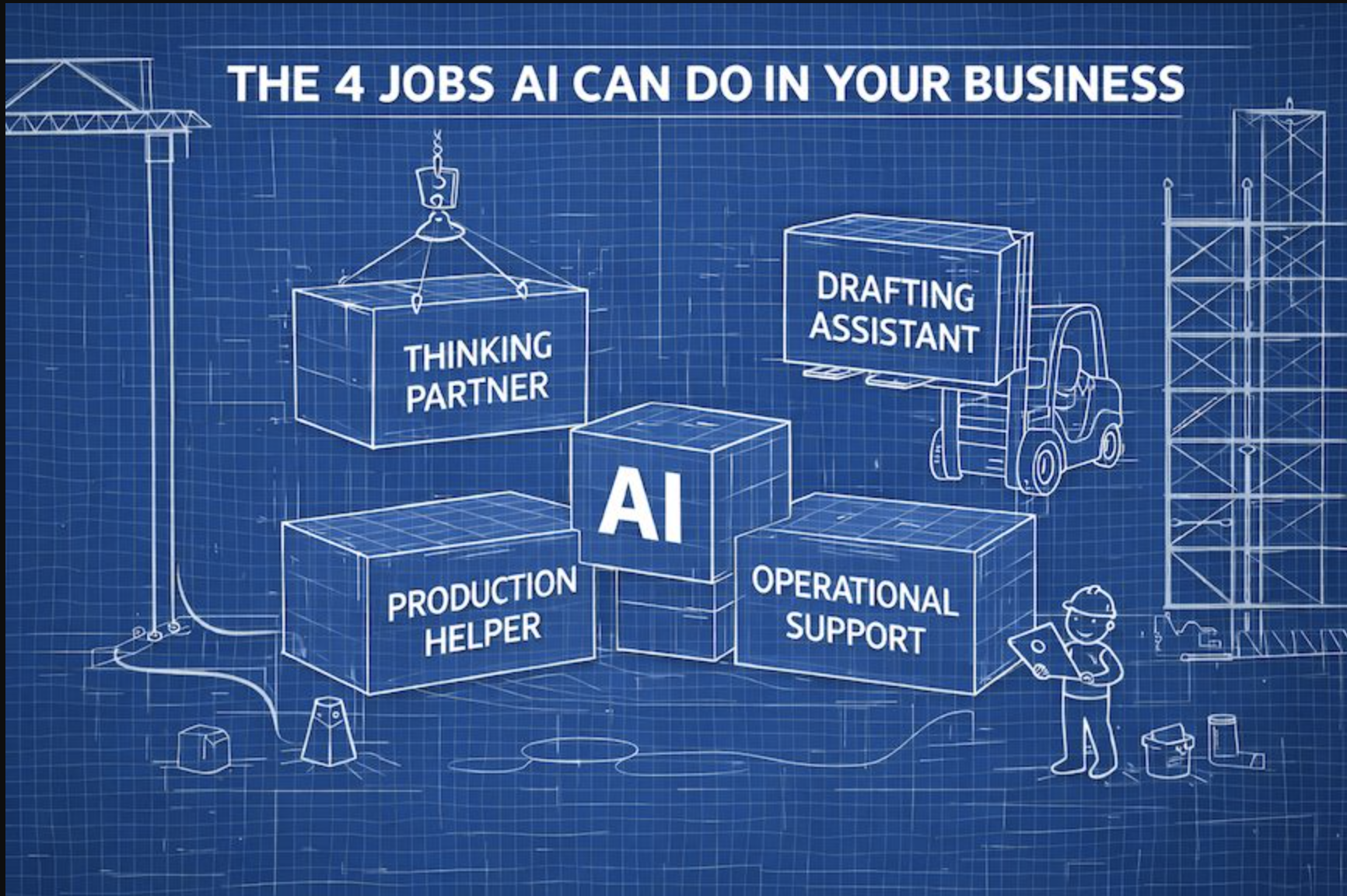
In most small businesses, AI ends up helping in four practical ways.
First, it helps you think.
Exploring ideas.
Stress-testing assumptions.
Summarizing research.
Helping you see options you may not have considered.
Second, it helps you draft.
Emails.
Marketing copy.
Social posts.
Documentation.
Third, it helps you produce.
Images.
Presentations.
Short videos.
Basic creative assets.
Fourth, it helps you operate.
Scheduling.
Customer support triage.
Internal knowledge searches.
Simple workflow automation.
Notice something important.
None of these roles replace human judgment.
They reduce the friction between thinking and doing.
When the problem is clear, the story is clear, and the constraints are understood, the tools become much easier to choose.
AI doesn't create strategy.
It amplifies it.
And that's where the real opportunity is for small and mid-sized businesses.
Not replacing people.
Helping good people move faster with clearer thinking.
Over the next post or two I'm going to talk more about the tools themselves.
Where people typically start, what categories exist today, and how small businesses can experiment without getting overwhelmed.
If you're running a small or mid-sized business and trying to make sense of all this, feel free to reach out. These are the kinds of conversations I enjoy having.
AI doesn't need to be mysterious.
But it does benefit from a little thoughtful planning.