Building Be Awesome
Building Be Awesome #5: A Marketing Guru I Ain't
Let's start with the numbers.
About a month into this little experiment we have:
- One product sold.
- 223 social media followers.
- 57 store visitors.
So, obviously, world domination is proceeding exactly according to plan.
Or maybe not.
But that's kind of the point.
When I started Building Be Awesome, one of the things I wanted to find out was whether all of the promises about AI making it easier to start a small business were actually true.
Could someone take an idea, use readily available tools and AI, and turn that idea into an actual business without spending months learning every discipline involved?
The answer, so far, is yes.
We have a store.
We have products.
We have a brand.
We have social media accounts.
We have a Pinterest board.
We have reusable templates.
We have run an actual marketing campaign.
We have even sold something to someone.
That's not nothing.
In fact, that first sale taught us something important.
Our first customer wasn't a friend. They were a friend of an Instagram friend. That's only one degree beyond the people who already know me, but it's the first tiny bit of evidence that be awesome. can move through another person and reach somebody new.
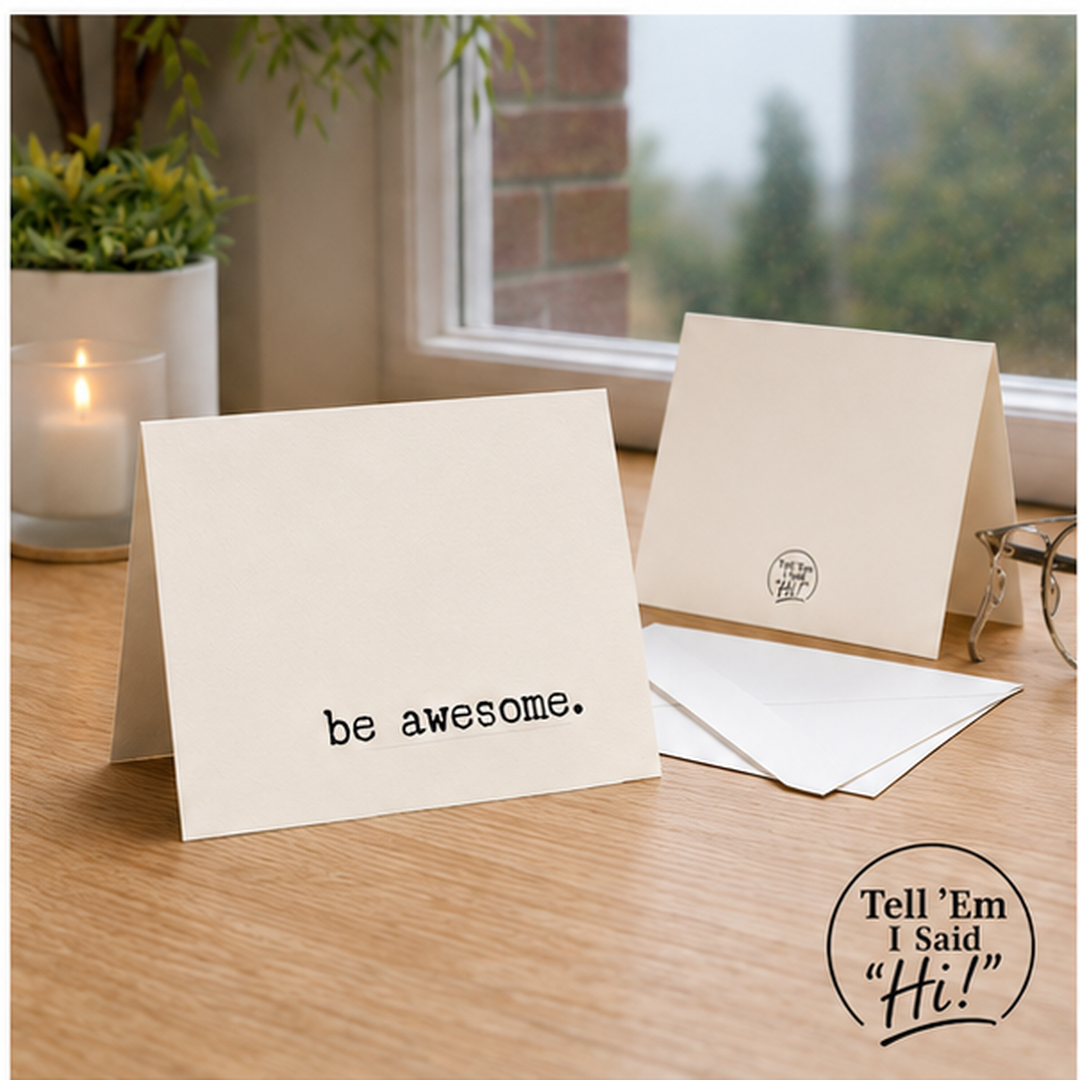
One sale is not a business model.
But it is not zero.
And somewhere along the way we discovered something that should surprise absolutely nobody:
Getting a store online and turning a store into a selling machine are several different horses of several different colors.
And a marketing guru I ain't.
We Stopped Reinventing the Wheel
One of the least glamorous things we have done may turn out to be one of the most important.
We built reusable social media templates.
That sounds ridiculously mundane until you think about what happened before they existed.
Every post started with something resembling:
"Okay, we need a graphic."
Then came choices about size, background, typography, logo placement, spacing and all of the other little things that have nothing whatsoever to do with what we actually wanted to say.
Now we have a system.
The templates aren't the marketing.
They remove enough friction that we can spend more time thinking about the marketing.
That's a very Building Be Awesome lesson.
Even a tiny business eventually needs infrastructure.
Ours happens to include a Keynote template and several Markdown files instead of a warehouse.
We Ran an Actual Campaign
Then something wicked awesome came this way.
Our be wicked awesome. shirt gave us an excuse to try something we hadn't done before: run a real, multi-day campaign.
We teased it.
We developed a visual identity around it.
We played with Boston and New England language without turning it into a pile of regional clichés.
We used music.
We built anticipation.
We revealed the product.
We created our first giveaway.
We even made a Reel.
Then we made the Reel again because the first one had two soundtracks.
Progress over perfection, remember?
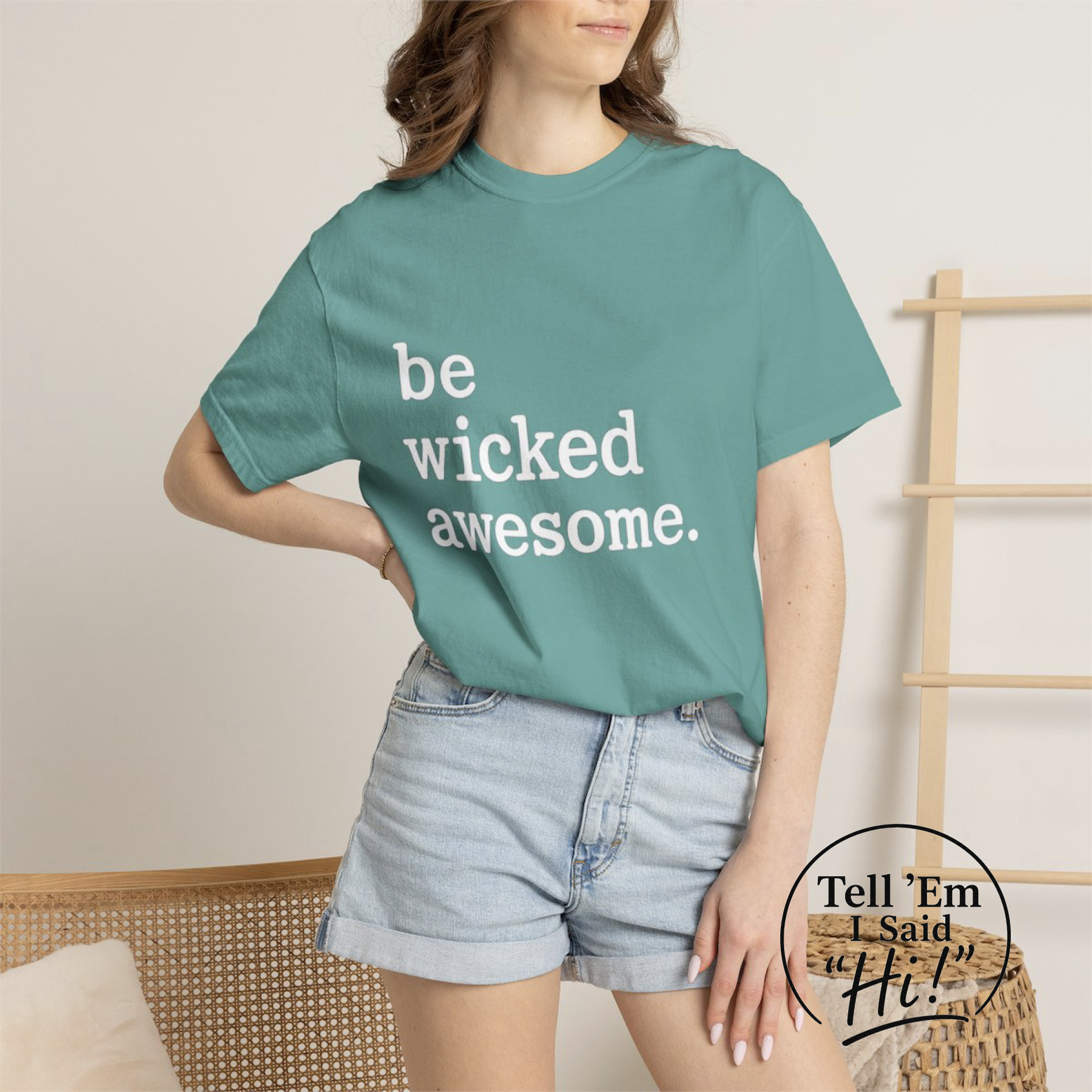
For the first time, Tell 'Em wasn't simply somebody occasionally posting a picture of something available in an Etsy shop.
It behaved, however briefly, like a brand.
That distinction matters.
We Made a Schedule
We also stopped asking ourselves every morning:
"What the hell should we post today?"
There is now a loose rhythm to the week.
Some days are about the be awesome. message.
Some are stories or observations.
Some show what is happening behind the curtain.
Some feature products.
Some are intended simply to start a conversation.
That last one may be more important than I understood when we started.
Because social media is not really a catalog.
People generally don't open Instagram in the morning thinking:
"I certainly hope someone shows me a mug I can purchase."
They're there for people, entertainment, ideas, stories, distraction, connection and occasionally a video of a golden retriever stealing a sandwich.
Our little business has to earn its place among all of that.
The Store Is Not the Business
This may be the biggest lesson of the first month.
There is an enormous ecosystem built around making it easy to create things to sell online.
Etsy makes opening the storefront easy.
Printify makes putting a design on something easy.
Canva makes creating graphics easy.
AI can help with product descriptions, brainstorming, research, copy, campaign ideas, technical problems and all sorts of other things.
Put those pieces together and you can get from "I have an idea" to "I have a store" remarkably quickly.
That's the part everybody advertises.
What happens next is harder.
The store exists.
Now somebody has to care.
You cannot automate that into existence.
You can certainly optimize for discovery. You can improve keywords, listings, photography, captions, hashtags and posting schedules. You can experiment with platforms and formats.
But those things create opportunities to be discovered.
They do not create relationships.
And I'm increasingly convinced that the relationship is where the interesting part begins.
Followers Aren't Customers Wearing Disguises
It would be easy to look at 223 followers and decide that the next goal should be 500.
It would also be easy to get there by following hundreds of accounts, joining engagement games, or chasing whatever trick the algorithm is rumored to reward this week.
But followers for followers' sake would give us a larger number without answering the question we actually care about:
Are we reaching people who believe in the idea enough to share it, visit the store, or bring one of these reminders into their lives?
Ten thousand people who scroll past everything we do aren't nearly as interesting as a few hundred who occasionally stop, smile, comment, share something with a friend or wonder what we're going to do next.
Eventually, yes, some of them need to buy something.
This is still a business experiment.
Revenue matters.
Profit matters.
If the thing can't eventually sustain itself, that's useful information too.
But "get more followers" isn't much of a strategy.
The Constitution says people first.
The story matters.
Optimize for joy.
None of that means we should be embarrassed to sell something.
It means the sale should be the result of trust, relevance and a product worth owning, not pressure.
A warm brand can still use a clear call to action.
What we really need is more of the right people discovering us, more of those people choosing to stick around, and more reasons for them to come back.
Which means the next phase isn't really about shouting louder.
It's about becoming more interesting.
The Next Four-ish Weeks
So we're going to run another experiment.
For the next month or so, we're going to concentrate less on adding things and more on learning how to create an audience around the things already here.
Not a grand marketing strategy.
Four small experiments.
Week One: Finish the Wicked Experiment
We'll complete the be wicked awesome. launch and giveaway and pay attention to what people actually do, not merely what we hoped they would do.
Did people share it?
Did they comment?
Did they visit the profile?
Did they follow because they wanted a free shirt and immediately disappear, or did some of them stick around?
We'll announce the winner, talk to people, and see what we learned.
The giveaway isn't a shortcut to a big audience.
It's an experiment in whether a particular story gives the right people a reason to participate.
Week Two: Make the Store Earn the Click
Social media can deliver a visitor.
It cannot make a confusing listing persuasive.
So we'll look at the Etsy shop through the eyes of somebody who has never met me, hasn't followed this experiment, and has absolutely no reason to give us the benefit of the doubt.
Can they understand what we're doing?
Are the products clear?
Do the images answer the questions a buyer would actually have?
Does the listing explain both what they're buying and why it exists?
And we'll improve what is already there before creating a dozen new things.
More products is not the goal.
Better products are.
Week Three: Build Conversation, Not a Catalog
We'll keep following our social schedule long enough to actually learn something from it.
The feed shouldn't become a parade of product mockups.
We'll tell stories.
We'll share things worth sending to somebody.
We'll show mistakes and decisions behind the scenes.
We'll ask questions when we actually want to hear the answers.
We'll show the products in the context of the idea that created them.
And we'll participate in other conversations like human beings.
No dropping links everywhere.
No hollow "Great post!" comments.
No following people because they somehow owe us a follow in return.
Real comments.
Real conversations.
Familiar names over time.
Week Four: Follow the Signal
Then we'll look at what happened.
Not every post has the same job, so we're not going to pretend every number means the same thing.
Instead, we'll look at the path:
people reached → meaningful engagement → profile visits → Etsy visits → favorites → purchases
We probably won't have enough data for beautiful conclusions.
That's fine.
We need direction, not statistical theater.
Which stories caused people to respond or share?
Which posts caused people to visit the profile or store?
Which products got attention once people arrived?
What took an enormous amount of effort and produced almost nothing?
What surprised us?
Then we'll decide what deserves another iteration.
Ship.
Observe.
Learn.
Improve.
Repeat.
The Small Scoreboard
We do need a scoreboard.
Once a week we'll capture a handful of things:
- follower growth
- reach, especially beyond existing followers
- shares, saves and meaningful comments
- profile visits and store clicks
- Etsy visits, favorites, orders and revenue
- what we published
- what people actually said
Our baseline is:
One sale.
223 followers.
57 store visitors.
Those numbers aren't necessarily clean enough to calculate some glorious conversion percentage to three decimal places.
That's okay.
Going forward, we'll take consistent snapshots so we have something honest to compare.
The goal for the next four-ish weeks isn't viral growth.
It's evidence of a healthier path.
More of the right people discovering us.
More of them deciding we're interesting enough to visit.
Some deciding the thing we've made belongs in their lives.
If follower growth is slow but sharing, store visits, favorites and sales increase, that's progress.
If follower growth explodes and none of those things move, that's a lesson too.
What We're Not Going to Do
We're not buying followers.
We're not playing follow-for-follow games.
We're not going to spray generic comments across other people's posts hoping they'll wander back to ours.
We're not going to manufacture fake urgency every 48 hours.
We're not going to turn every encouraging thought into "BUY THIS SHIRT NOW."
And we're not going to confuse activity with progress.
Could some of those tactics make certain numbers climb faster?
Probably.
But those aren't the numbers we're trying to build.
If Building Be Awesome is going to grow, I want it to grow because somebody found something worth returning for.
The Part Where Marketing Becomes Human Again
I used to think the difficult part would be opening the store.
It wasn't effortless.
There were accounts, integrations, fees, listings, product images, descriptions, tags, samples, templates and several moments when my AI collaborators confidently wandered into the shrubbery.
But the store exists.
The harder part is earning attention without demanding it.
It's showing up consistently without becoming repetitive.
It's telling a story without turning every story into a sales pitch.
It's asking someone to buy without forgetting why we made the thing in the first place.
I can build the technology.
I can create the systems.
I can measure things.
AI can sit beside me and play strategist, researcher, critic, copywriter and occasionally the annoying person in the meeting who asks whether we've considered something obvious.
But none of that guarantees people will care.
That's something we have to earn.
That is not one problem.
That is several different horses of several different colors.
For the next month, we're going to learn how to ride them.
Probably not all at once.
That seems unsafe.
Our Day's End Questions
Decisions Made
We will pursue meaningful reach, store traffic and buying intent, not follower count by itself.
We will run four small weekly experiments before adding more channels or a pile of new products.
Questions Raised
Which stories travel beyond the people who already know us?
Where does the path from social post to Etsy listing break down?
Which product gives people the clearest reason to bring be awesome. home?
Next Action
Complete the be wicked awesome. campaign, capture the baseline and begin a simple weekly scorecard.
Be awesome.
And tell everyone we said "Hi!"